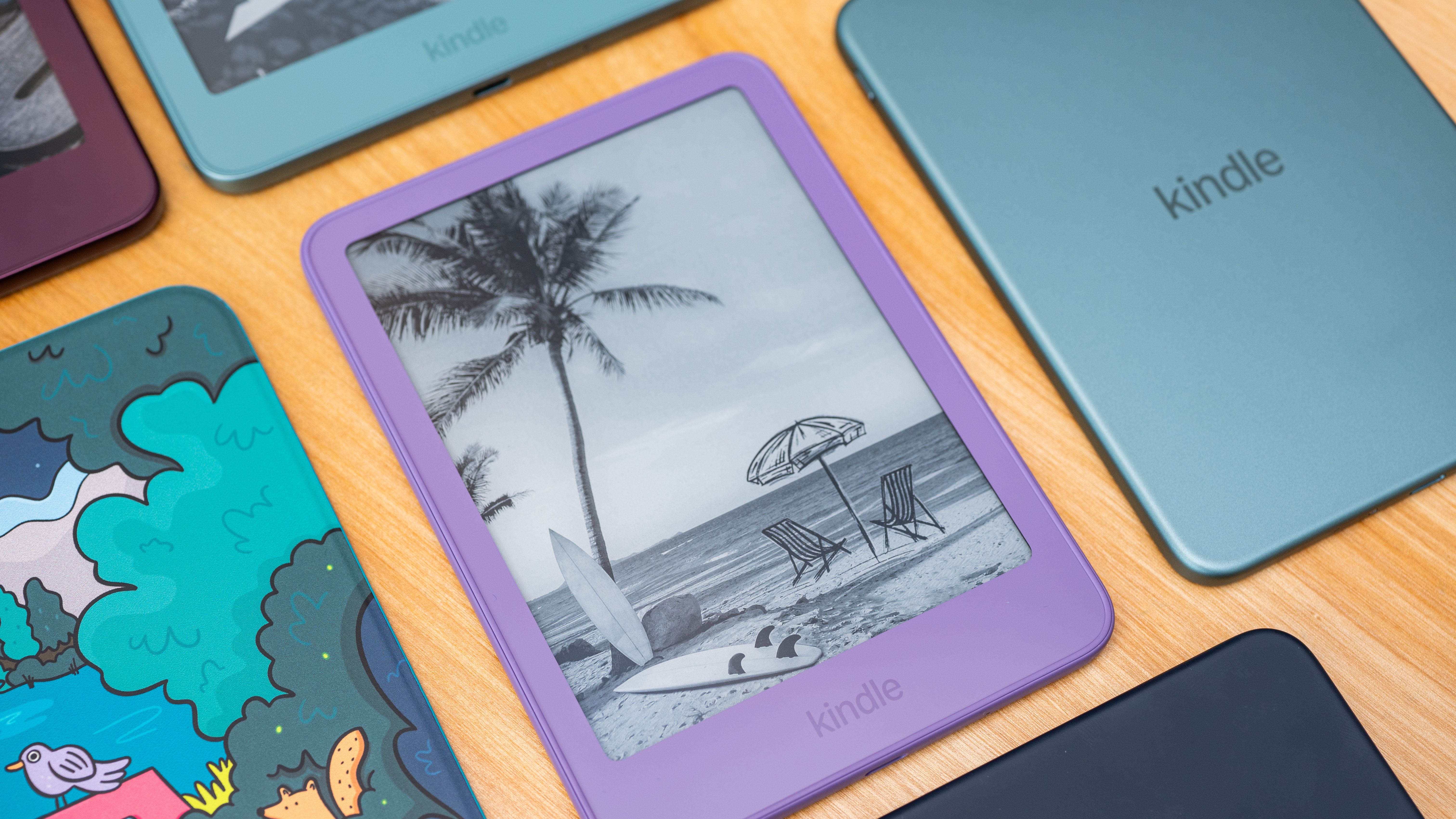
The Kindle will turn 20 in 2027. Amazon says it plans to celebrate the milestone throughout the year, but to kick things off, it's starting with an entirely refreshed Kindle lineup. On Thursday, the company introduced a handful of new Kindle models: a new 6-inch base Kindle, a 7-inch Kindle Paperwhite, and a 7-inch Kindle Colorsoft.
You can buy Signature Editions of the latter two and Kids versions of the entire range, which include artist-designed kids cases, a year of Amazon's worry-free guarantee for damage, and a year of Kids+ , the company's subscription service that offers unlimited access to ad-free, child-appropriate books. The highlight is Amazon's use of aluminum for the Kindle's construction rather than traditional plastic. The starting tier is plastic, but you can upgrade to an all-aluminum model (Amazon uses 80 percent recycled aluminum) if you prefer that Kindle model and you just want something more robust.
It can get a little confusing with all the different SKUs, so here's a quick rundown: Kindle (plastic, 16 GB, lock screen ads): $150 Kindle (aluminum, 32 GB, no ads): $190 Kindle Paperwhite (plastic, 16 GB, lock screen ads): $200 Kindle Paperwhite Signature Edition (aluminum, 32 GB, no ads): $250 Kindle Colorsoft (plastic, 16 GB): $290 Kindle Colorsoft Signature Edition (aluminum, 32 GB): $320 Kids Kindle (available for every model): $180+ Lighter and Premium The base Kindle, the aluminum version, and the Kids Kindle are on sale starting today. The Paperwhite and Colorsoft are available for preorder on a rolling basis and will launch at the end of October. The base Kindle's screen offers 30 percent faster page turns than its predecessor, Amazon says.
The build is a whole millimeter thinner at 6.8 mm, and Amazon cut the weight by around 18 grams to 140 grams. The Kindle Paperwhite and Colorsoft are both similarly lighter (204 grams) and thinner (6.8 mm), retain the waterproof design, and feature adjustable warm reading lights. The screen refreshes 30 percent faster than the base Kindle, and the screen has a higher pixel density that makes text appear sharper.
Amazon says the new Kindles are also compliant with the European Union’s new battery regulations, meaning they should be easier to remove and replace. Upgrading to the Signature Edition for both nets you the aluminum build, an ambient light sensor that adjusts brightness automatically, an accelerometer that lets you turn the screen to landscape orientation and have the pages adjust accordingly. The upgrade also adds the ability to use a double-tap gesture to turn pages.
Uniquely, the Signature Editions feature pogo pins that let you charge via Amazon's new $60 dock, which props the device up as it charges. There's also a new Page-Turn Cover ($80)—a case with physical page-turn buttons that magnetically attaches to the back of the devices and pairs via the pogo pins, which Amazon says offers page-turn buttons to the vocal minority that still loves them (around 5 percent of Kindle users) without adding unnecessary bulk to the device. Don't worry, you don't need the case, the Signature Edition, or even a new Kindle if you just want page-turn buttons.
Amazon is debuting its own Kindle Click, a $35 page-turn accessory that pairs over Bluetooth for the non-Signature (and older) Kindle models. Kindle Ablaze The Kindle business is booming. Amazon's Kevin Keith, vice president of product, says Kindles have seen double-digit growth over the last three years, with 2025 being the highest sales year in more than a decade.
He says 60 to 65 percent of people buying new devices have never had a Kindle before, with Gen Z, millennials, and even Gen Alpha driving the lion's share. This past January saw the highest single-month Kindle reading volume in history. At the same time, Kindles are more expensive than ever.
“Memory pricing is a little bit crazy,” Keith says, referring to the memory shortage behind the general price bump on all electronics. Amazon upped prices of existing Kindles earlier this year; the new devices match those prices. Part of the redesign aims to lower overall manufacturing costs and standardize the hardware.
Take the refreshed display on the base Kindle—Keith says many of the improvements trickle down from the development of the Kindle Scribe . For the first time, the base Kindle has a display that sits flush with the body, just like its pricier counterparts. (It previously had a raised plastic bezel around the screen.) That whole front panel is also available in a new color: Ube (purple). While Amazon has made Kindles with colorful fronts (like the matcha green Kindle from 2024), it hasn't done this with flush displays.
That's because simply coloring the front would make the Ube color, for example, scatter around the screen as the frontlight reflects it, casting a purple hue on the display. To counter this, Keith says Amazon developed a new “edge-to-edge” color technology that prints two different colors under the cover lens: the Ube color backed by a layer of black. The black absorbs the light, which solves the problem.
Amazon says it perfected this tech in the Scribe and ported it down here. Color is important. Keith says alternative colors typically make up just 15 to 20 percent of sales—the rest being classic options like black or white—but the matcha green model captured a surprising 55 percent.
Amazon also chose that color because, at the time, it noticed a general increase in the popularity of matcha in drinks and sweets (it also noted that folks on #BookTok are reading in coffee shops). Hence the new ube color, which is based on the popular purple yam of the same name. “We've been tracking food trends, and two years ago, ube just exploded—ube was growing 200 percent year over year,” says Chris Green, Amazon's vice president of design.
“We expect it to do far better than the matcha.” For the aluminum housing, instead of milling the device's frame from a block of aluminum and using a lot of water in the process, Amazon stamps a flat sheet, which then goes into a forge that presses down to create the backplate and sides. The process supposedly takes seconds compared to the hours it can take to machine a single aluminum device frame (like an iPhone or MacBook) saving material and energy. It helps lower the Kindle's carbon footprint, which is now equivalent to 11 hardcover books.
Green says these improvements bring down the device's density. The density of the average human body is around 1 gram per cubic centimeter; an iPhone is around 2.2 grams per cubic centimeter. The new Kindles are around 1.2 grams.
Lowering that number can help make the hardware “disappear” during prolonged use. “I truly want people to never think about the Kindle,” Green says. “I just want them to think about the magical world that the author has created inside of this device.” For Green, who has designed nearly all of Amazon's hardware in his 19-year tenure at the company (and yes, he says he's embarrassed by the Fire Phone ), chasing that 1.2-grams-per-cubic-centimeter target is all about getting the gadget out of the way so the Kindle can mimic the analog calm of physical print.
“More people are reading on paper, more people are reading on Kindles,” Green says. “Is it a backlash to AI? Probably.
People are trying to find things more authentic—we're in a crisis of authenticity.” Surveys have shown that overall leisure reading is down across the US , but the people who are reading are buying more than ever . As for the 20th anniversary of the Kindle in 2027, Keith says the company may roll out a significant refresh to the Kindle's user interface, though he didn't share more. Expect special anniversary editions of some Kindles.
When I asked whether we could expect the return of the Kindle Oasis —an asymmetrical e-reader with physical page-turn buttons—Green chuckles. “The first Oasis was one of my passion projects,” he says. “I loved that.
I really, really loved that product. But I was a vocal minority on that—most of the people wanted slabs.” So, probably not.
Source: WIRED